
Sub-Total: $0.00
Private Security is the Sleeping Giant of Public Safety
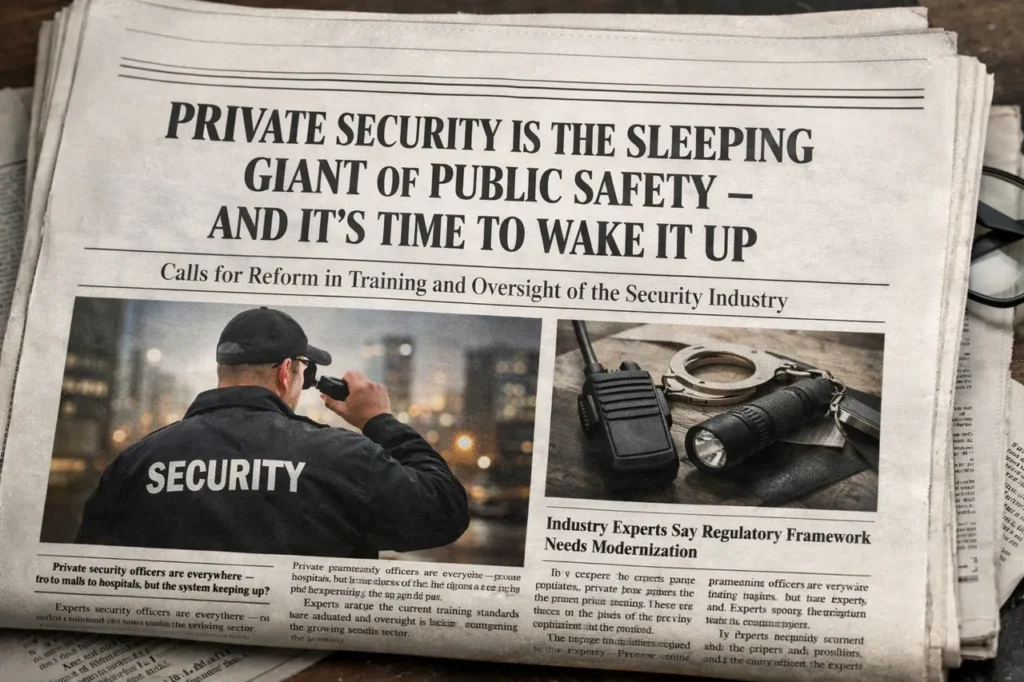
Private Security Is the Sleeping Giant of Public Safety – And It’s Time to Wake It Up
Brian D. Baxter, MS
Walk into any hospital, refinery, church, corporate campus, or shopping center in Texas and you will likely see private security officers quietly doing the work that plays a major role in keeping business functioning and communities safe. They are visible everywhere, yet the public rarely understands what they do. Even inside the industry, many people have never been given a clear picture of what private security could be if it were allowed to evolve into a true profession instead of simply a licensed and state-regulated workforce.
Texas has one of the largest private security labor pools in the country. It also has a regulatory system built for licensing and enforcement, not leadership. The private security industry in Texas is overseen, licensed and regulated by the Texas Department of Public Safety – Regulatory Services Division (RSD). RSD does many things well. It ensures that people entering the field meet minimum standards. It maintains a basic licensing structure. It enforces compliance. At its core, however, the parent agency of RSD is a law enforcement agency, not a security agency. Its mission, its training culture, its expertise, and its worldview center on policing Texas. That is not criticism of the agency, it’s an observation of a simple, structural mismatch. Police are experts in police work. Private security is a different mission. Right now, Texas is treating the latter like a watered‑down version of the former.
Licensing, Training, and the Mismatch Problem
Licensing tells you who can enter the field. Professionalization tells you what the field must become. The current training curriculum for private security is one of many illustrations of the problem. Much of it is adapted from police academy lesson plans. That is understandable because DPS trains police, regulates police and understands police. But private security officers do not operate under the same constitutional or statutory authority or performance mandates. They largely operate under contract authority, civil liability, and a presence-and-prevention model.
When you try to train one like the other, you create confusion instead of competence, competition instead of continuity. Security officers are taught concepts that do not match their mission profile. They are taught sources of authority that do not actually apply. They are trained for encounters they will likely never face and undertrained for the most common occurrences. The curriculum is not maliciously designed. It is simply inherited from a policing framework that does not translate directly to private security.
EMS provides a useful constructive comparison. Although there are parallels and similarities, EMS training isn’t born of adaptations from nursing school. Additionally, most EMS agencies in Texas are privately owned or operated by private contractors, yet they integrate seamlessly with definitive care. Hospitals and trauma centers rely on EMS because each component part of the continuity of healthcare has clear scopes of practice, independent certification bodies, appropriate accredited training programs and priorities, and similar cultures of continuous improvement. EMS does not replace doctors or nurses. It complements them. Private security could function the same way if its training and standards were built intentionally instead of being borrowed.
Private investigators offer another example. They do not replace police detectives. They supplement investigative functions for insurance companies, law firms, corporate compliance units, and civil litigation. Their value comes from specialization, not imitation. When trained well, they elevate the entire ecosystem of fact‑finding and honest accountability, including expert witness work that supports courts and administrative reviews.
Authority, Role Confusion, and the Off‑Duty Police Issue
Another challenge rarely discussed publicly is the widespread use of off‑duty police officers in roles that should be filled by licensed private security professionals. Many officers take off‑duty “security” jobs on private property without holding a Private Security Program license or being contracted through a PSP regulated company. This undermines the regulatory framework and creates legal and operational conflicts.
Police officers derive their authority (and equipment, training and bonding) from the government and the taxpayer. Their powers exist because the state grants them based on the consent of the governed. They cannot act as agents of private property owners as private security personnel can. They cannot enforce house rules as private security personnel can. Nor can they apply contract authority or operate under the policies and SOPs of a private security company unless they are licensed and contracted through that company.
When off‑duty officers take private security jobs without PSP licensing, they operate outside the regulatory structure designed for private security. They may exceed the authority appropriate for the contracted role. They displace PSP‑regulated companies and officers who are trained for the specific mission. They blur the line between public authority and private contract work, and here’s the quiet part out loud, off-duty police are take paying contracts from properly licensed contracting companies. Contracts that generate revenue much more in line with where private security compensation should be. This means that security companies and security officers continue to be aligned, trained, funded and compensated as afterthought, not the cooperative, public safety priorities they could be.
If Texas wants a strong private security industry, it must insist that private security work be performed by private security professionals who are trained, licensed, and regulated under the PSP framework.
A Systems Approach: Moving Beyond the “Name, Blame, Shame, Punish or Retrain” Cycle
A recent incident illustrates a deeper symptom of the problem. A security officer in Carlsbad was arrested after deploying a less-lethal weapon into the face of a man at point‑blank range. The video circulated widely. The officer was arrested. The company issued a statement and likely wrote a big ole check. That will likely be the end of it.
There will be no systemic review of private security standards and training in California. No examination of whether the curriculum prepares officers for decision-making during real‑world encounters. No evaluation of policy, SOP, or supervision. No discussion of whether the officer was placed in a role beyond his preparation. No assessment of whether the industry’s standards contributed to the failure.
Instead, the response will follow a familiar pattern. Identify the individual. Blame the individual. Shame the individual. Punish or retrain the individual. Write the check. Then move on.
This cycle feels decisive, but it is not corrective. It treats every failure as a personal failure instead of a system failure. It assumes the problem is the officer rather than the training, the policy, the supervision, the expectations, or the regulatory structure that shaped the officer’s behavior.
Private security cannot afford this approach. The stakes are too high, and the workforce is too large. A systems approach recognizes that individual actions are shaped by training, policy clarity, stress, perception, supervision, and organizational culture. When an incident occurs, the question should not be “Who is at fault?” but “What in our system allowed this to happen, and how do we prevent it from happening again?”
Until private security adopts a systems mindset, it will continue to repeat the same failures while insisting that the failures are isolated. They are not isolated. They are predictable outcomes of a system that has never been modernized.
Raising the Bar: Policy, SOP, Training, and Professional Expectations
The private security industry also has internal challenges. Many companies operate at the minimum standard because the minimum standard is all that is required. Training is often treated as a cost instead of an investment. SOPs are frequently generic templates that would struggle to survive a lawsuit or a critical incident review. Officers are hired as warm bodies instead of trained professionals. Documentation practices are inconsistent. Supervisors are promoted based on tenure and availability rather than experience and competency.
The industry is not suffering from bad actors. It is suffering from low expectations and low expectations create high liability.
If private security wants to be taken seriously by clients, regulators, and the public, it must build the same structural backbone that other professions rely on. That means policy that defines authority, limits, and expectations. It means SOPs that translate policy into action. It means training that builds decision‑making instead of checkbox compliance. It means human‑performance science that prepares officers for stress, perception challenges, and critical incidents. It means documentation systems that protect officers, companies, and clients. It means honest accountability that reinforce professionalism.
This is the work Performance‑Critical focuses on, not just because it keeps the lights on, but because it is necessary. The industry cannot evolve without it.
The Missing Piece: An Independent Standards Commission
There is one missing piece that regulators, owners, and officers all quietly recognize. Texas private security in Texas has no independent body that sets the bar. There is no organization that defines training standards, certifies instructors, accredits companies, establishes ethical expectations, advocates for officer wages, modernizes curriculum, partners with RSD, prioritizes the public, and protects the industry.
Texas needs a nonprofit, independent standards commission. Not more bureaucracy. More leadership. A body that can do for private security what NREMT does for pre-hospital medicine, what IADLEST does for law enforcement, what BAR associations do for lawyers and what so many other professional boards have done for their respective professions. A body that can raise expectations, modernize training, and create a culture of professionalism that matches the scale of the industry.
Private security deserves to become a true profession, but that can only happen if we invest in real infrastructure and training. Officers must demand real preparation and compensation. Regulators must partner with industry instead of simply policing it and all of us must agree that checking the box for the minimum standard is no longer enough.
Private security is the sleeping giant of public safety. Texas can wake it up and lead the nation if we raise the bar together.