
Sub-Total: $0.00
Make a Decision!
Make a Decision!
The Cynefin Framework
By Brian D. Baxter
In public safety professions such as law enforcement, corrections, security, and military policing, individuals are routinely expected to perceive accurately, think clearly, and respond appropriately even in tense, uncertain, and rapidly evolving situations. These expectations are often reinforced through policy, training assessment, and post-incident review processes. While understandable, they are frequently inconsistent with what is known about the limits of human performance, particularly cognition and decision making under stress. Research consistently demonstrates that perception, cognition, and response are highly sensitive to context, often more so than to training and experience. The Cynefin framework (Figure 1) provides a structured way to understand why expectations formed in stable environments often fail when applied to real-world use-of-force encounters and other time-compressed decisions (Snowden & Boone, 2007).
The Cynefin framework describes five domains or conditions: Clear (formerly Simple or Obvious), Complicated, Complex, Chaotic, and Disorder. Each domain reflects a different relationship between cause and effect and requires a different approach to decision making. The framework’s central insight is that decision quality, particularly when reviewed in hindsight, depends less on individual competence and more on whether the decision-making approach matched the context in which the decision occurred (Snowden & Boone, 2007). This distinction is foundational to Honest Accountability.
Where Expectations Are Formed
In Clear contexts, cause and effect are stable and predictable. Best practices apply, and deviations are easily identified. In public safety, this includes routine, policy-driven tasks such as handcuffing a compliant suspect, conducting a pat-down with no resistance, or moving inmates in a familiar, controlled environment. In sports, it resembles rehearsed actions such as a free throw, a kickoff, or a passing route. Under these conditions, consistent perception and rule-based responses are reasonably expected because the Clear environment and luxury of time support them.
Complicated contexts still allow cause and effect to be understood, but only through expertise and analysis. Tactical planning for a warrant service, contingency planning, and last-minute intelligence integration fall into this category. In sports, this may involve choosing the hand-off option over the pass based on a sudden shift in the defense. These situations still support analytical thinking, what Kahneman (2011) describes as System 2 processing, as long as time and cognitive resources are available.
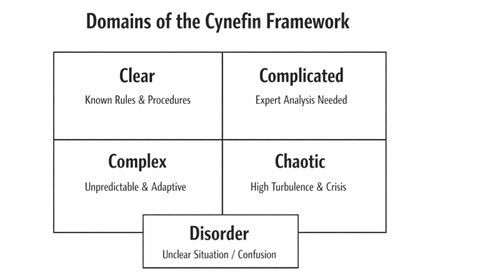
Figure 1. The Cynefin Framework domains applied to decision-making context.
Importantly, many expectations about officer perception, judgment, and performance are formed in Clear and Complicated contexts. Problems arise when those expectations are later imposed on Complex or Chaotic events, particularly during post-incident review with the benefit of knowing how the story ended. Honest Accountability requires acknowledging that expectations developed in one domain do not automatically transfer to another (Kempermann, 2017).
Human Behavior Changes the System
Complex contexts dominate many real-world use-of-force encounters. In these situations, cause and effect are not predictable in advance, and outcomes emerge through interaction. Human behavior adapts to officer actions, tone, distance, timing, and presence. Domestic disturbances, emotionally disturbed persons, crowd management, and volatile correctional housing units are common examples.
In Complex domains, Cynefin emphasizes a probe–sense–respond approach rather than analysis followed by execution (Snowden & Boone, 2007). Officers who are able to make contact and establish rapport may test small verbal and tactical interventions, observe behavioral changes, and adjust accordingly. This aligns with Realistic De-Escalation as informed by Dr. John Azar-Dickens’ TEB Model, which emphasizes the interaction between threat perception, emotional state, and behavioral output. The model recognizes that behavioral influence is contingent, time-limited, and highly sensitive to stress and emotional dysregulation (Azar-Dickens, 2025).
Sports offer a parallel example. A receiver navigating traffic on a third-and-long play cannot consciously evaluate every possible route or defensive adjustment. Decisions rely on pattern recognition and fast, frugal adaptations. An after-action review may reveal missed opportunities, but due to the limits of human perception and cognition, those options were likely not equally available to the receiver in real time.
Bottom Line: Action Often Comes Before Full Understanding
Chaotic contexts occur when there is no discernible cause-and-effect relationship in the moment. Immediate action is required to stop harm and stabilize the situation. Active assailant events, ambushes, and sudden assaults fall into this domain. Cynefin’s guidance here is act–sense–respond (Snowden & Boone, 2007).
Under extreme stress, working memory capacity is reduced, attention narrows, and analytical processing slows (Kahneman, 2011). Officers rely on schema (brain blueprints), trained responses and heuristics rather than comparative analysis. Klein’s recognition-primed decision-making model explains how experienced professionals identify patterns, select workable responses, and mentally simulate outcomes (Klein, 1998). Expecting analytical comparison in chaos exceeds human capability and violates the principles of Honest Accountability.
Disorder exists when individuals cannot agree on which domain applies. In these situations, people default to comfort zones, increasing coordination problems and risk.
The key implication is not that standards should be lowered, but that they must be contextual and realistic. Expectations must be unambiguous and remain within the limits of human performance, including perception, reaction time, and decision making. Across public safety and high-level sport, effective performance under pressure is not about perfection, but about context-appropriate action.
References
Azar-Dickens, J. (2025). The TEB model: A new approach to crisis assessment and intervention. BookLogix.
Kahneman, D. (2011). Thinking, fast and slow. Farrar, Straus and Giroux.
Kahneman, D., & Klein, G. (2009). Conditions for intuitive expertise: A failure to disagree. American Psychologist, 64(6), 515–526.
Kempermann G. (2017). Cynefin as Reference Framework to Facilitate Insight and Decision-Making in Complex Contexts of Biomedical Research. Frontiers in neuroscience, 11, 634
Klein, G. (1998). Sources of power: How people make decisions. MIT Press.
Snowden, D. J., & Boone, M. E. (2007). A leader’s framework for decision making. Harvard Business Review, 85(11), 68–76.