
Sub-Total: $0.00
“I Was Wrong, but I Was Telling the Truth”
“I Was Wrong, but I Was Telling the Truth”
Vision, Attention, and the Honest Limits of Human Memory
Brian D. Baxter, M.S.
Introduction
Imagine interviewing a witness to a shooting. Earlier that night she watched as her cousin was gunned down right in front of her eyes. The witness gives a crystal clear account of her cousin, running toward the safety of her home from a man with a gun in his hand. She watches in terror as her cousin is shot multiple times as he crosses the threshold of her doorway. Bleeding. Glass from her door shattering from gunfire as her loved-one falls dead at her feet. The witness’ statement would be very important to the subsequent prosecution, would it not?
The problem is that the physical evidence, including doorbell video footage, blood spatter and other witness statements revealed that her cousin had not been shot in her doorway at all. He had, in fact, been shot in the parking lot, at a considerable distance from her door. But why did she report facts that were clearly in conflict with the historical truth? Was she lying?
When it comes to human memory, people can be 100% honest, 100% confident, and 100% wrong. There are a lot of places to start a conversation about why people sometimes don’t remember or remember incorrectly events that occurred within their view. Let’s start with the following declaration. Human memory is not a video recording.
What we remember is not recorded on our brain as a movie is recorded on a digital camera. What we remember is constructed from what we looked at, what we focused our attention on, what we missed, and how our brains subsequently filled gaps to make sense of the situation. That process can and does contribute to sincere testimony that does not match the physical record, even when the person has nothing to gain from lying and no desire to deceive anyone.
This article draws on research in vision, attention, and memory to help explain some, but certainly not all of the reasons that the discovery of imperfect memory and memory errors should not just be accepted; it should be expected.
Vision and attention decide what can be remembered
A recent Force Science News article detailed the role of two visual systems in situational awareness. Absent a disability, vision is indeed the primary tool that our brain uses for information gathering. We are used to talking about vision as if our eyes simply “take in” everything in front of us and we create one single image of our surroundings. In reality, our ambient and focal visual systems work together to build a collage of images based on that to which we paid attention. Vision and attention work together to decide what gets processed in detail and encoded, and what is left as an unattended blur in the background.
Joan Vickers’ “quiet eye” research shows that expert performers do not look everywhere at once. Instead, they settle their gaze for a final steady period on the most crucial cue just before they act, whether that is the rim of a basket, the corner of a goal, or an opponent’s torso (Vickers, 2016). That “quiet eye” period improves performance precisely because it filters out distractions and channels attention into a very narrow slice of the scene.
Marc Green, who has written extensively about driver perception and perception response time, stresses a similar point in the context of traffic collisions. The fact that a hazard was “in view” for several seconds on a dash camera or in a computer reconstruction does not mean the driver processed it. Drivers allocate attention to what they expect will matter most, and under load they simply fail to register some hazards in time (Green, et al., 2008).
These same principles apply in high threat encounters. Force Science Co-Founder and internationally recognized human performance expert Dr. Bill Lewinski has long argued that under intense stress officers’ direct attention to survival relevant details such as hands, weapons, and avenues of escape. Much of the rest of the scene receives only minimal processing, if any at all (Lewinski, 2002). If attention never settles on a detail, that detail has little chance of being stored in memory, no matter how clearly it is remembered by someone else or how prominently it appears in a video recording.
“There is growing consensus that the brain does not passively process the input it receives from the eyes in order to provide us with a visual representation of our environment, but instead continuously generates predictions about what the world should look like.”
(Jolij, J. et al., 2011)
Jolij and colleague’s research indicates that images that we see result from a complex system that involves more than just the eyes. Vision involves multiple lobes of the brain, environmental stimuli and even our mood. The processes, known as the ventral and dorsal streams help us use our experience and knowledge combined with what we are looking at in order to identify objects (our “what” vision) as well as where the objects are in relation to us and our surroundings (our “where” vision). In this, and other ways, the brain is a predictive tool more so than a recording and storage device. We don’t see with our eyes, we see with our brain.
What the brain sees and what the camera records
Dr. Nick Murray, Dr. Lewinski, and others put this issue under a microscope in a recent study, the first of its kind, comparing what an officer looks at to what an officer’s body camera records.
Participant officers completed a live, scripted use of force scenario while wearing two key devices. One was a standard chest mounted body camera. The other was a pair of eye tracking glasses that recorded exactly where their eyes were directed, along with head movements. The study revealed a great deal of information. Chief among the findings were the answers to two questions based on multiple pre-defined critical cues strategically placed throughout the scenario.
Based on the eye-tracking footage, how often were officers’ eyes directed to those critical cues? How often did the body camera footage capture those same events in its frame?
“Officers attended more critical events with their eye movements than were captured by the body-worn camera, highlighting that cameras miss important visual cues that shape rapid decision-making.”
(Murray et al., 2024)
The results were striking. Officers’ eye tracking data showed that they attended to roughly eighty percent of all critical incidents in the scenario. The body camera view, by contrast, captured only about two thirds of those same events, and it was especially poor at recording some of the key actions that helped explain the officers’ decisions. In fact, over seventy-five percent of the information that officers used to make force decisions was not recorded on the body camera.
The technical data told a similar story. When the researchers compared gyroscope and accelerometer readings from the head mounted eye tracking system with those from the chest mounted camera, the correlation was low. In plain language, the camera often pointed in a different direction than the officers’ functional field of view. Their eyes were making quick, targeted shifts toward threat cues and other important information, while the camera stayed locked to the chest and offered a broad but relatively shallow view. One of the key takeaways from this research is that we can never, not even when using eye-tracking equipment, know where or on what a person’s attention is focused and what they subsequently saw or will be able to remember.
Nideffer’s quadrants of attention
Almost fifty years ago, Robert Nideffer offered a useful way to think about attention by describing it in four quadrants: broad versus narrow, and internal versus external. Those dimensions create four attention styles or quadrants (Figure 1). Although people can switch rapidly between quadrants, they are unable to occupy more than one quadrant at a time. As a result, if a person is focused internally, they are unlikely to be consciously aware of things happening externally.
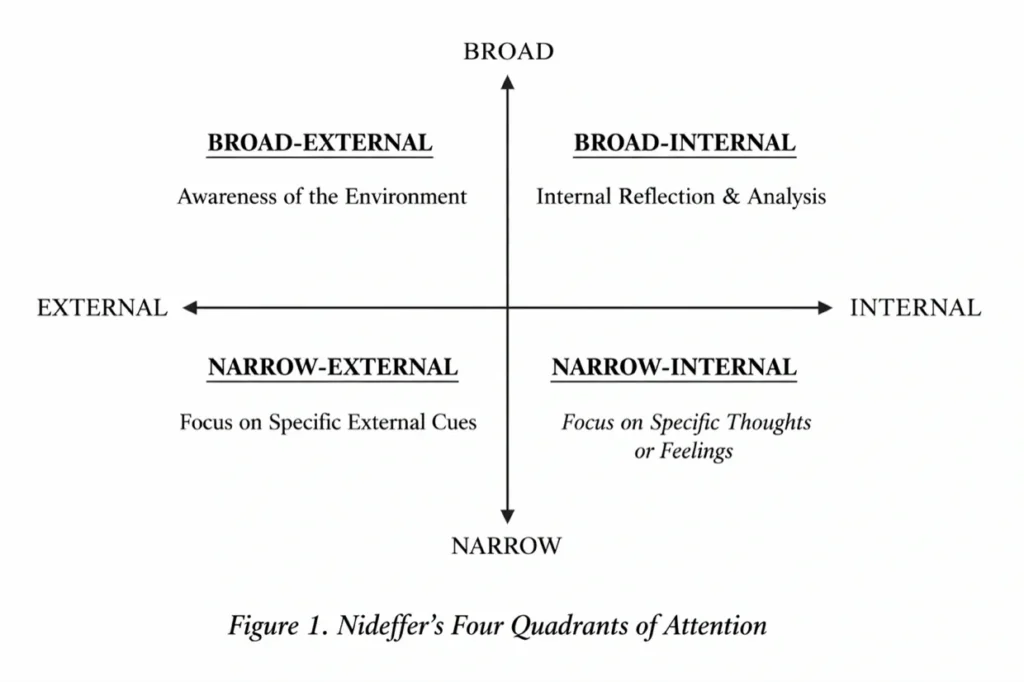
External and broad attention is allocated to scanning the environment for general patterns and multiple cues. Imagine a quarter back scanning the positions of defensive players prior to the ball being snapped. External and narrow attention locks onto a single focal point, such as a weapon or a particular person. Imagine a pitcher visually focusing intently on the mitt of the catcher prior to sending a fastball toward home plate.
Internal and narrow attention focuses on a single thought or bodily sensation, such as “My foot hurts”, or “I don’t like this food”. There is often an involuntary shift to internal focus of attention, like what happens when we stub our toe. Internal and broad attention tracks the overall condition of oneself. “I’m hungry” or “I’m scared” are examples of an internal broad focus of attention. Imagine a person recoiling in fear of an armed attacker and almost disassociating from events going on around them.
“Under conditions of high stress, attention tends to narrow, reducing the amount of information an individual is able to process, even when additional cues are available.”
(Nideffer & Sharpe, 1978)
During moments of threat or challenge, we benefit from an external and narrow focus of attention. This visual narrowing is exactly what we need for success or survival. But it is maintained at the expense of other aspects of the scene occurring outside of our narrow focus. These aspects may later be important to investigators, but they were never given much attention because they were gated out by the narrow attentional focus.
Within Nideffer’s framework it would be surprising if a person with an external and narrow focus of attention could provide a detailed, accurate description of everything caught by a wide-angle camera. Similarly, it would be unlikely that a person with an internal focus of attention would remember much at all of what the camera caught. The evidence suggests that people remember that which occurred in the quadrant of attention they were in at the time. In other words, what people are able to remember is limited to what they paid attention to.
From attention to memory
Even when attention is well directed, memory has hard limits. Research by Edward Vogel and colleagues indicates that visual working memory, the temporary mental workspace we use to hold visual information, has a very small capacity. On average, people can maintain about three or four separate objects or features at once (Vogel & Luck, 2013). In a complex, rapidly changing scene this means that much of what passes through the eyes is not attended to and therefor never makes it from this short-term sensory storage to working memory.
Matthew Peterson’s research on visual search found that working memory and attention are tightly linked. When people must remember several items while they search a visual display, their search slows and their eye movements become less efficient (Peterson et al., 2001). In a real encounter, an officer may be trying to track multiple moving people, monitor the location of cover, listen to radio traffic, and keep tactical options in mind. The limited capacity of working memory guarantees that some of this information will be sloughed off.
“Memory is reconstructive rather than reproductive; details that were not central to the officer’s attention during the event are less likely to be encoded and later recalled, even though they may be visible on video.”
(Hope, L., et al., 2016)
This is particularly true when the excessive cognitive load is accompanied by fatigue from a protracted event or encounter as demonstrated in research conducted by Dr. Lorraine Hope, Dr. Lewinsky and others in collaboration with the Peel Regional Police.
Anna Nobre and colleagues have demonstrated that attention can be directed not only to incoming sensory information but also to items held in working and long-term memory, strengthening those items and making them more likely to be remembered later (Nobre et al., 2025). What a person chooses to focus their vision and attention on, or what their vision and attention are drawn to involuntarily, will heavily influence what is encoded and what fades.
Taken together, this work shows that encoding is selective at two levels. Attention decides what reaches working memory. Working memory capacity, along with rehearsal or significant association, then decides which of those attended items are robust enough to be consolidated into longer term memory. Details that seem obvious on slow motion video may never have made it through both gates.
Further research by Dr. Hope, Dr. Lewinsky and colleagues in collaboration with the Winnipeg (Manitoba) Police Service revealed that what we pay attention to, what we disregard, and subsequently are able to remember is also affected by our physical state. For example, if we are physically exhausted after running for safety or fighting for our lives, the literature says that we will likely be able to recall less information than if we were not exerted (Hope, L., et al., 2012). Not to be confused with fatigue, and independent of the limited capacity of working memory mentioned earlier, exhaustion can contribute to inattention which can create gaps in our memory.
Memory gaps, construction, and confabulation
Once information is encoded, it does not sit in storage unchanged. Memory is a constructive process. Daniel Schacter describes normal memory errors as the seven sins of memory, including transience, where memories weaken with time, bias, where current beliefs shape recollections, and suggestibility, where new information is folded into old memories (Schacter, 2001).
Elizabeth Loftus has shown repeatedly that post event information can alter what witnesses later remember. In classic misinformation studies, simply changing the verb in a question about a traffic collision, from “hit” to “smashed,” altered witnesses’ estimates of speed and even led some to “remember” broken glass that did not exist.
When people encounter media coverage, conversation with others, or even body camera footage of their own event, those new inputs can blend with their original memory. The person is usually not aware of which parts come from lived experience, and which come from later exposure. They experience a single coherent story that feels entirely genuine and is reinforced every time the person recalls the memory of the experience. We don’t remember an event. We remember the last time that we remembered an event.
“Memory does not work like a video recording; it is reconstructive, and what people later remember can be altered by new information, expectations, and the questions they are asked.” (Loftus, 2005)
A similar thing occurs when a person fills gaps with what makes sense to them based on their knowledge and experience. For example, the woman mentioned at the beginning of this article was positive that she had seen her cousin shot in her doorway. What the investigation revealed, however, was that her cousin had been shot in the parking lot and then ran to her door for shelter. As he entered the doorway, his shoulder broke the glass door. The woman, having heard a gunshot, seen her cousin bleeding, hearing and seeing the glass break in her doorway and then seeing another man with a gun, was left to make sense of it all. The story that she swore to be the truth was the single, coherent story that felt entirely genuine and got reinforced every time she recalled the memory of the experience.
Confabulation is a clinical term for more extreme versions of this sense making or gap filling. People who confabulate may produce detailed and confident accounts of events that are not accurate, without any intent to deceive. Neurological injury and some psychiatric conditions can increase the rate of confabulation, but milder, everyday versions of the same process occur in otherwise healthy individuals.
In a legal setting, that means an individual can sound very sure about details that are partly confabulated. The presence of such detail should not automatically be taken as proof of intentional fabrication. It may simply reflect the mind’s natural tendency to fill gaps and make sense of chaos with plausible material.
Recall versus recognition, why testimony can change
Memory is commonly tested in two ways. Recall tasks people to produce information on their own. Recognition tasks present options and ask people to choose the one that is familiar. In school terms, recall is like a fill in the blank question or an essay prompt. Recognition, on the other hand, is like a multiple-choice question. The same idea applies in investigations. An initial narrative statement is largely a recall task. Later, when a witness conducts a scene walk through or is shown diagrams, photographs, or video, they are essentially performing a recognition task.
“The inability to recall specific details during an initial interview does not mean that those details were not perceived or encoded, as recognition-based memory often remains intact even when free recall is limited.”
(Hope, L., et al., 2016)
Experience tells us that recognition is easier and quite often more accurate than pure recall, because the environment supplies cues and partial matches that help reconstruct the stored memory trace. In practice, this means that we should expect a witness’s account to evolve as they move from recall only to recall plus recognition. Not to mention the positive effects that time and sleep have on memory consolidation. Details left out in the first telling may be added after viewing video. Some earlier statements may be corrected. When understood through the lens of cognitive psychology, those changes are signs that different memory processes are being engaged, not necessarily of dishonesty.
Why an honest witness can still be wrong
Putting these threads together, the path from real event to courtroom testimony passes through several narrow gates. During the event, attention collapses into survival relevant quadrants, especially narrow external and broad internal focus, as described by Nideffer. Many details outside of that quadrant never receive focused attention.
Even within the focus of attention, working memory capacity, as described by Vogel and others, can hold only a few items at once. Some information is inevitably gated and lost before it can be consolidated. Encoding is guided by where attention is directed. Salience to success or survival, training, experience, and immediate goals all shape that direction.
After the event a person is exposed to conversations, media, and video review which can all introduce new material. As Schacter and Loftus show, memory is updated and reconstructed, not simply replayed. That reconstruction process can fill gaps and alter details while preserving the core storyline (Schacter, D.L., 2001).
As Dr. John Black and Force Science’s President and Chief Communications Officer point out in a 2020 Force Science News article entitled, “Honest but not Accurate”,
“Even though research continues to provide reasonable explanations for memory gaps and perception distortions, trying to distinguish lies from “honest but not accurate” police reporting is an issue that continues to incite controversy and division across the country today”.
Vision research demonstrates that human gaze and body cameras do not provide the same record of an event. Cameras capture critical cues that officers miss and simultaneously miss a significant portion of the critical cues that officers see.
Some questions to ask ourselves when a person’s memory doesn’t comport with video or other evidence are:
– Is their memory consistent with how selective attention would realistically have been allocated in that situation?
– Are the errors mostly about peripheral details that fall outside the likely visual focus?
– Are changes across statements consistent with normal recall and recognition effects and the influence of new information, rather than with a shifting motive?
If the answer to these is yes, then the science strongly supports the conclusion that the person is honest but not accurate. Their memory is not a camera. It is a living system that reconstructs an account of an event based on what the person looked at, what they focused their attention on, and even what they missed.
Bottom Line
Vision, attention, and memory together shape what any witness can truly know about an event, particularly a critical event. Research on working memory and attentional control demonstrates that only a handful of elements can be actively maintained at one time. Studies on reconstructive memory, misinformation, and confabulation show that gaps are filled and stories reshaped without conscious intent to deceive.
Cameras do not represent an accurate account of a witness’s experience during an event. Most importantly for modern investigations, body camera footage is not the same as the officer’s lived experience. The camera’s field of view and movement pattern differ from those of the human eyes, and they miss a substantial portion of critical cues that officers attend to.
When we understand these findings, we stop expecting people to perform like video cameras. We recognize that honest, well-intentioned individuals can make real mistakes in their recollections, especially of events that occurred under conditions of high threat. For anyone tasked with judging their actions and their character, that understanding is not an excuse. It is a necessary correction to an unrealistic model of the human mind.
Just hours after a dangerous arrest at the Vancouver International airport during which a suspect died in police custody, officers gave their statements to interviewers. Months later, a video surfaced and revealed information that had not been reported by the officers involved. The interviews didn’t match the video. In fact, the interviews didn’t even perfectly match each other. One of the officers, after being charged with perjury, made a profound statement that contributed to the dismissal of charges as well as the title of this paper. The officer said, “I was wrong, but I was telling the truth”.
References
Green, M., Allen, M.J., Abrams, B.S., & Weintraub, L. (2008). Forensic Vision with Application to Highway Safety.
Hope, L., Blocksidge, D., Gabbert, F., Sauer, J. D., Lewinski, W., Mirashi, A., & Atuk, E. (2016). Memory and the operational witness: Police officer recall of firearms encounters as a function of active response role. Law and Human Behavior, 40(1), 23–35.
Hope, L., Lewinski, W., Dixon, J., Blocksidge, D., & Gabbert, F. (2012). Witnesses in Action: The Effect of Physical Exertion on Recall and Recognition: The Effect of Physical Exertion on Recall and Recognition. Psychological Science, 23(4), 386-390.
Jolij, J., Meurs, M., & Haitel, E. (2011). Why do we see what’s not there? Communicative & integrative biology, 4(6), 764–767.
Lewinski, W. (2002). Rethinking reaction time. Police magazine.
Loftus, E. F. (2005). Planting misinformation in the human mind: A thirty-year investigation of the malleability of memory. Learning and Memory, 12, 361 to 366.
Murray, N. P., Lewinski, W., Allen, C., Sandri Heidner, G., Albin, M. W., & Horn, R. (2024). The eyes have it: Functional field of view differences between visual search behavior and body worn camera during a use of force response in active-duty police officers. Police Practice and Research, 25(4), 490 to 497.
Nideffer, R. M., & Sharpe, S. (1978). Attention control training. In J. H. Goldstein (Ed.), Sports, games, and play (pp. 231 to 246).
Nobre, A. C., Gong, D., & Draschkow, D. (2025). Focusing attention in working and long-term memory through dissociable mechanisms. Nature Communications.
Peterson, M. S., Kramer, A. F., Wang, R. F., Irwin, D. E., & McCarley, J. S. (2001). Visual search has memory. Psychological Science, 12, 287 to 292.
Schacter, D. L. (2001). The seven sins of memory: How the mind forgets and remembers. Houghton Mifflin.
Vickers, J. N. (2016). Quiet eye research on visual control of action. Current Issues in Sport Science, 1, Article 118.
Vogel, E. K., & Luck, S. J. (2013). Visual working memory capacity from psychophysics and neurobiology to individual differences. Trends in Cognitive Sciences, 17, 391 to 400.