
Sub-Total: $0.00
“Attitude Tickets”
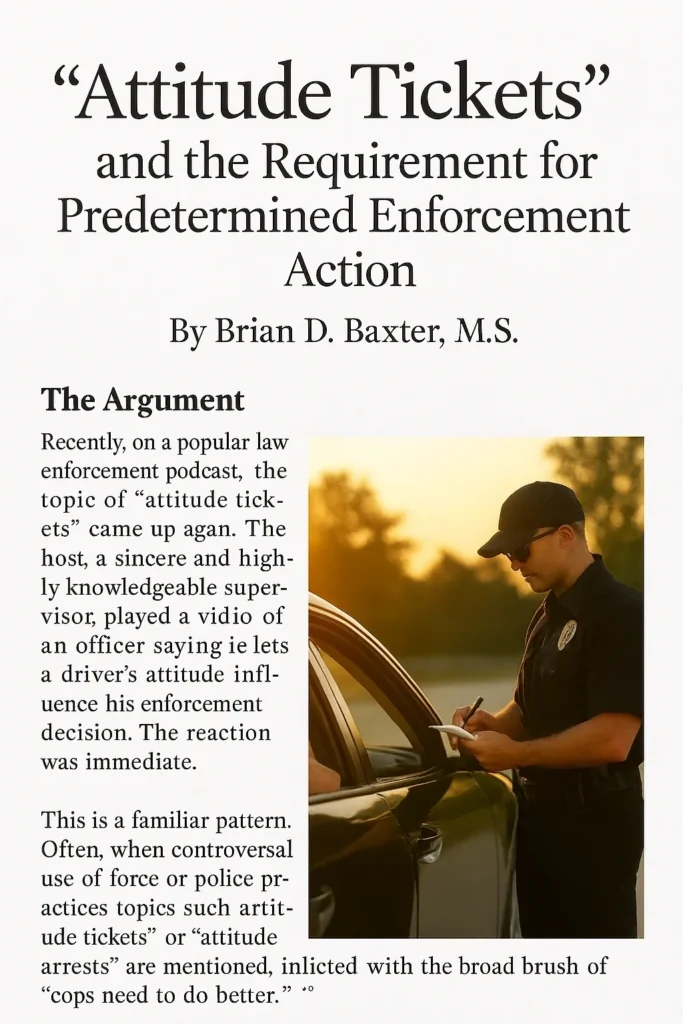
“Attitude Tickets” and the Requirement for Predetermined Enforcement Action
By Brian D. Baxter, M.S.
The Argument
Recently, on a popular law enforcement podcast, the topic of “attitude tickets” came up again. The host, a sincere and highly knowledgeable supervisor, played a video of an officer saying he lets a driver’s attitude influence his enforcement decision. The reaction was immediate. The idea was dismissed. The officer was criticized, and the profession, not just that officer, was once again indicted with the broad brush of “cops need to do better.”
This is a familiar pattern. Often, when controversial use of force or police practices topics such as “attitude tickets” or “attitude arrests” are mentioned, the conversation quickly collapses into a simplified moral conclusion. In this case, something along the lines of no one should be summoned to court or fined simply for failing to show deference to the police or for hurting an officer’s feelings. Most of us agree with that. That is not justice, and it is not good policing.
But the reality is more complicated than the soundbite. Traffic stops are dynamic encounters, and the idea that an officer should decide the enforcement action before approaching the vehicle ignores the fluid, information‑rich nature of real police work.
As a mentor of mine often says, “The answer to complexity cannot be found in simplicity. The answer to complexity is found in understanding.”
Why Requiring Predetermined Enforcement Doesn’t Work
The argument that officers should determine the enforcement action before making contact is rooted in a desire for fairness and objectivity. But it assumes that all relevant information is available to the officer at the moment the violation is observed. That is almost never the case.
Once the officer approaches the vehicle, new information emerges that can completely change the nature of the stop.
Example 1: The Simple Violation That Isn’t Simple
A driver rolls a red light.
The officer considers the context such as the time of day, traffic volume and pedestrian presence and decides a written warning is appropriate.
But upon contact, the officer discovers that the driver has no insurance, the vehicle is registered to someone else, and the driver cannot explain the discrepancy.
What began as a minor violation is now a legitimate investigation into vehicle ownership, financial responsibility, and potential criminal activity. The officer’s initial plan cannot override new information.
Example 2: The Repeat Offender Who Doesn’t Respond to Warnings
Same minor violation. Same initial decision: written warning.
But this time, when the officer runs the driver’s license history, it shows two previous written warnings for running the same red light at the same intersection. Additionally, the driver is dismissive, rude, and gives off a “whatever, dude” attitude, but the real issue is that warnings have clearly not changed the behavior.
The purpose of traffic enforcement is to gain voluntary compliance with the law. In this case, the new information shows that warnings are not effective with this driver. The question becomes:
Did the attitude cause the ticket? Or did the driver’s repeated, behaviorally demonstrated and procedurally documented disregard for the law require an escalation in enforcement action?
The answer is obvious. The ticket is not about attitude. It is about voluntary compliance with the law.
Example 3: The “Attitude Problem” That Isn’t About Attitude
Same minor violation. Same initial decision: written warning.
But this time, the driver greets the officer with profanity and hostility. While officers are not tasked or equipped to correct the manners of drivers, the officer hears slang associated with a known violent gang. She sees tattoos consistent with this driver’s membership in that gang. She identifies verbal statements indicating uncommon knowledge of a specific crime currently under investigation.
This is not about hurt feelings and disrespect. It is about reasonable suspicion and duty. The officer now has a legal and professional obligation to investigate further. Ignoring these indicators because of a predetermined plan to let the driver go with a warning would be negligent.
Attitude and Compliance Are Not the Same Thing
People often misunderstand what “compliance” means. Compliance is behavioral, not based solely on verbal utterances, tone of voice, or emotional dysregulation.
If an officer lawfully orders a driver out of the vehicle under Pennsylvania v. Mimms¹, and the driver shouts “No, EFF the police! I’m not getting out!” while actively stepping out of the car, that driver is compliant. They are verbally refusing while physically doing exactly what the officer instructed. While this conflict in words and actions may indicate a need for heightened alertness on the part of the officer, it does not (on its own) indicate non-compliance.
Compliance is not politeness. Compliance is not emotional regulation. Compliance is simply doing as instructed by the officer because it is required to safely complete a legitimate law enforcement objective.
Officers are trained to tolerate disrespect. They are not trained, nor permitted, to ignore indicators of danger, criminal activity, or evolving circumstances.
¹ Pennsylvania v. Mimms, 434 U.S. 106 (1977). The Court held that an officer has the authority and discretion to order a driver out of a lawfully stopped vehicle for officer safety.
What Actually Drives Enforcement Decisions
The “attitude ticket” myth survives because it contains a kernel of truth: officers should not take enforcement action against people for verbal provocation alone. But the leap from that truth to “officers must predetermine enforcement before contact” is where the logic breaks.
It assumes that all of the relevant information is available to the officer before the stop. It assumes that attitude is the only variable that changes. It also assumes that officers operate like machines executing a preset script and that real policing fits neatly into theoretical boxes. None of these assumptions hold up.
In reality, enforcement outcomes are shaped by the observed violation, contextual factors, information discovered during contact, driver behavior as it relates to safety and compliance, legal requirements and investigative responsibilities, all of which are leveraged through the officer’s discretion and grounded in training and clearly established and defined expectations.
Attitude alone does not dictate enforcement. But officers can’t just ignore new information simply because they had a predetermined plan.
Honest Accountability
This matters because officer decision-making and behavior is too often viewed and judged with the convenience of hindsight, often in the interest of some unclear and unestablished expectation that sounds intuitively positive but can have an unintended crippling effect on the role of police in society.
Honest Accountability has two parts:
- The expectation, whether rule, policy, or law, must be clear and unambiguous enough that a person can accurately predict the lawfulness of their own behavior.
- The expectation cannot exceed the limits of human performance.
The expectation that officers must strictly predetermine enforcement before approaching a vehicle fails the first part. Not only is the expectation unclear and undefined in the Constitution, case law, statute, policy, or training, it also creates a new problem and that is self‑doubt.
If an officer hears gang‑related language or sees indicators of criminal activity, are they investigating because of those clues? If they decided up front to write a warning, are they still allowed to keep looking when new information appears? Or does the predetermined plan bind them, even when the situation changes?
Are they “breaking the rule” by letting the person’s tone, profanity, or word choice influence their enforcement action? Will calling an audible result in a high value arrest or three days off without pay?
This is one of the dangers of holding people accountable to feel‑good concepts and “Generalized Police Practices” instead of clear, workable expectations that pass the Honest Accountability muster. It creates standards that sound noble but cannot be followed in practice. And when expectations are unclear, evaluations become unfair.
The answer is not to simplify policing, the answer is to understand it.